
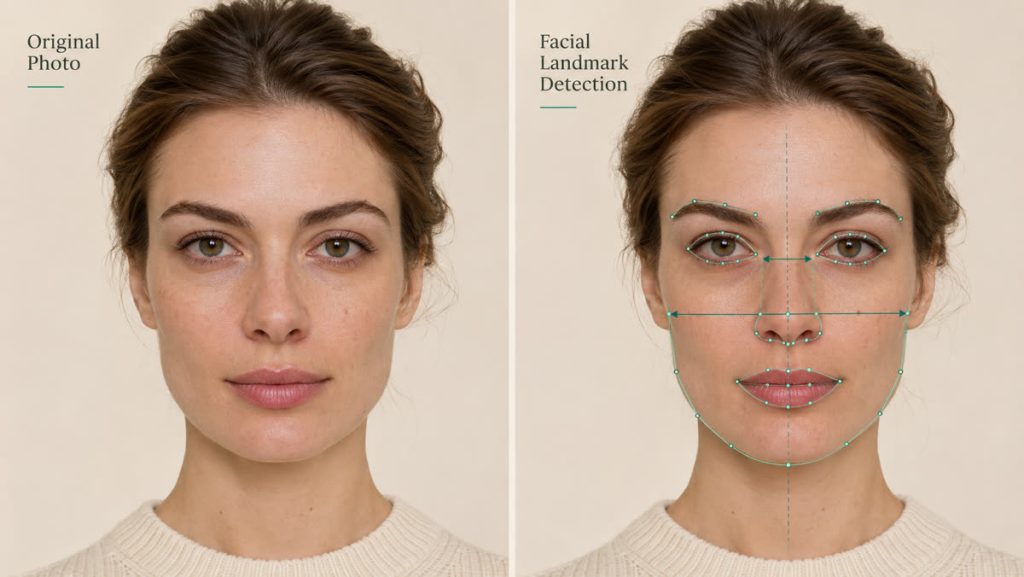
Artificial intelligence has introduced a new way to explore facial appearance. A beauty test uses a selfie to evaluate visible features such as symmetry, proportions, feature placement, and overall facial balance, then generates an estimated appearance score.
- What Is a Beauty Test?
- How Facefy’s AI Beauty Test Works
- How to Take a Beauty Test on Facefy
- What Does Your AI Beauty Score Actually Mean?
- Facial Features, Symmetry, and the Golden Ratio Explained
- Face Shape and Other Facial Analysis Metrics
- Why People Use AI Beauty Tests
- Privacy and Ethical Considerations
- Tips for Getting More Consistent Beauty Test Results
- The Future of AI Beauty Analysis
Unlike traditional appearance ratings based entirely on personal opinions, AI facial analysis focuses on measurable characteristics. It can help people explore facial proportions and styling options, although these measurements cannot determine real-life attractiveness.
This guide explains the technology behind AI beauty tests, how facial measurements influence results, and the limitations of numerical beauty ratings.
What Is a Beauty Test?
A beauty test is an AI-powered facial analysis that evaluates visible facial characteristics and generates an estimated appearance score.
Most AI beauty tests examine several factors, including:
- Facial symmetry and proportional balance.
- Eye shape, spacing, and positioning.
- Nose and lip proportions.
- Jawline definition and cheekbone prominence.
- Overall face shape.
- Relationships between different facial features.
Depending on the platform, scores may appear on a scale of 1 to 10 or 0 to 100.
These tools provide a different perspective on facial appearance rather than establishing a universal standard of beauty.
How Facefy’s AI Beauty Test Works
For anyone interested in exploring the technology behind facial analysis, Facefy offers AI-powered tools that examine facial proportions and geometric relationships. Its Facefy AI attractiveness test provides an estimated appearance assessment based on a photograph.
The analysis generally involves several stages.
Facial Landmark Detection
Computer vision identifies key points around the eyes, eyebrows, nose, lips, cheekbones, chin, and jawline.
These landmarks help establish the relative positioning of facial features. Some facial analysis systems identify more than 100 landmarks to estimate distances and angles.
Facial Symmetry Analysis
The AI compares corresponding features on both sides of the face, examining differences in positioning, distances, and angles.
Minor differences between the two sides are completely natural.
Proportional Assessment
The system examines relationships between facial measurements, including eye spacing, face length, and jaw width.
These measurements contribute to an assessment of facial balance. Some systems use golden ratio proportions as a reference rather than a definitive rule.
Beauty Score Generation
The analysis produces a face score, sometimes presented as an attractiveness score, based on the model’s evaluation criteria, and AI Face Analyzer-style tools can return results in seconds. It performs objective analysis of visible characteristics without altering the original photograph.
How to Take a Beauty Test on Facefy
Taking an AI beauty test requires a clear photograph that allows the system to identify your facial features.
- Open Facefy in your desktop or mobile browser.
- Upload a clear, front-facing photograph.
- Ensure your eyes, forehead, cheeks, and jawline are visible.
- Avoid strong filters, excessive retouching, and harsh shadows.
- Start the facial analysis.
- Review your estimated score and individual facial characteristics.
For more consistent results, use a photograph taken at eye level with even lighting and a relaxed expression.
Comparing photographs taken under similar conditions can help you understand how camera angles and lighting influence the analysis.
What Does Your AI Beauty Score Actually Mean?
An AI beauty score estimates how closely the facial characteristics detected in your photograph align with the model’s evaluation criteria.
A higher score generally indicates closer alignment with those criteria, while a lower score indicates greater variation. Neither result establishes how attractive you are to other people.
AI beauty tests cannot fully evaluate personality, charisma, confidence, movement, or individual style. Cultural preferences and personal tastes also influence perceptions of beauty.
Instead of focusing exclusively on the final number, examine individual observations about facial proportions, eye spacing, and face shape.
Facial Features, Symmetry, and the Golden Ratio Explained
AI beauty tests often incorporate measurements associated with visual balance and facial aesthetics.
Facial Symmetry
Facial symmetry describes the similarity between the left and right sides of the face. AI tools estimate symmetry by comparing corresponding facial landmarks.
Small differences in eyebrow height, eye shape, and jawline contour are normal. Perfect symmetry is not a requirement for attractiveness.
The Golden Ratio
The golden ratio, approximately 1.618, is a mathematical relationship sometimes applied to facial proportions.
Beauty analysis tools may compare selected measurements with golden ratio references. However, matching these proportions does not scientifically establish attractiveness.
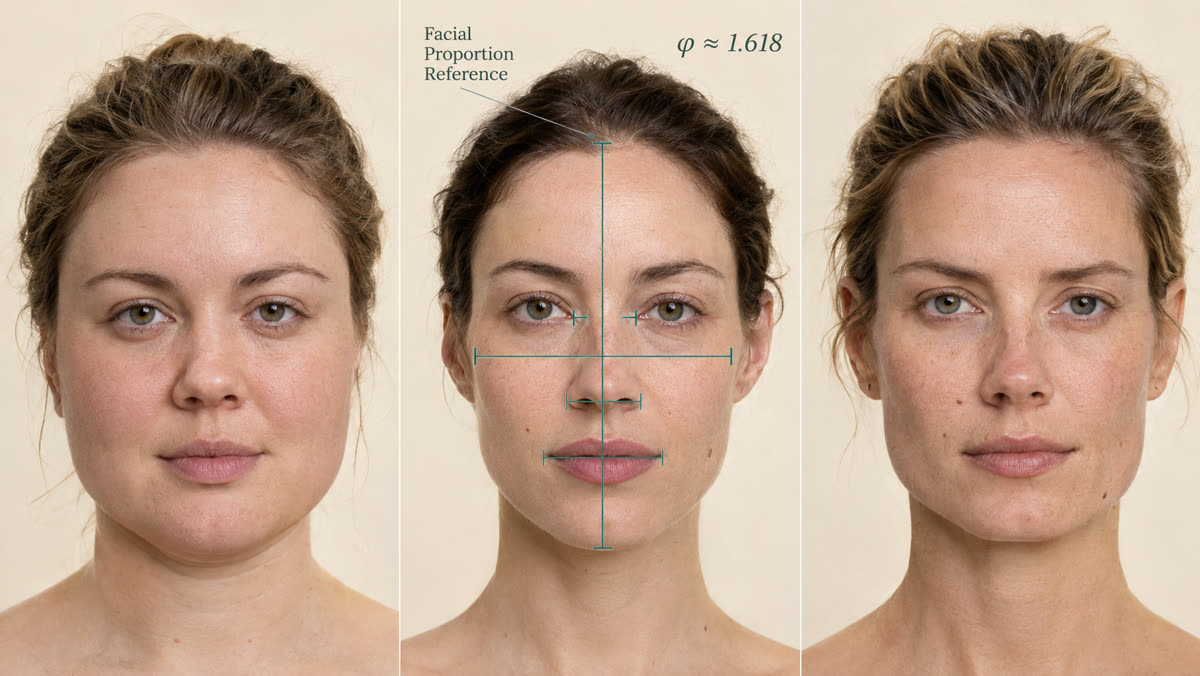
Individual Facial Features
The eyes, nose, lips, cheekbones, chin, and jawline contribute to facial appearance. Their visual effect depends partly on their relationships with surrounding features.
Facefy’s Beauty test offers a practical way to explore these relationships through AI analysis, helping users look beyond subjective impressions and understand the characteristics behind their estimated score.
Face Shape and Other Facial Analysis Metrics
An overall beauty score provides only one perspective on your appearance.
The Facefy Face Shape Detector examines your facial outline and proportions to identify your closest face shape category.
Common face shapes include:
- Oval: A longer outline with gently rounded contours.
- Round: Similar facial width and length with softer contours.
- Square: A relatively broad forehead and angular jawline.
- Heart: A wider upper face that narrows toward the chin.
- Diamond: Prominent cheekbones with a narrower forehead and jaw.
- Oblong: A noticeably longer facial outline.
Understanding your face shape can help you explore hairstyles, glasses, and makeup techniques.
Other facial analysis tools may estimate apparent age, eye shape, jawline definition, and facial ratios. Each provides a different perspective on your appearance.
Why People Use AI Beauty Tests
AI beauty tests offer an accessible way to explore facial characteristics that may be difficult to assess independently.
People commonly use these tools to:
- Understand facial structure and proportions.
- Explore hairstyle and makeup possibilities.
- Compare photography angles and lighting conditions.
- Experiment with grooming choices.
- Discover individual facial characteristics.
For example, changing your hairstyle can alter how your forehead, cheekbones, and jawline appear without changing your underlying facial structure.
However, repeatedly checking beauty scores or comparing results with others can encourage appearance-related concerns. Treat facial analysis as a resource for curiosity and styling rather than a fixed personal ranking.
Privacy and Ethical Considerations
Facial photographs contain sensitive personal information, making privacy important when using online beauty tests.
Before uploading a selfie, review the platform’s privacy policy and check how photographs are processed, stored, and potentially reused. Browser-based processing may reduce privacy risks when images remain on your device.
AI beauty assessments may also reflect biases within their scoring systems. No single model can represent every cultural beauty preference or individual aesthetic judgment.
Consumer facial analysis tools cannot diagnose skin conditions, determine biological age, or replace professional medical assessments.
Tips for Getting More Consistent Beauty Test Results
Photo quality influences how clearly AI can identify facial landmarks. Follow these recommendations to reduce avoidable variations:
- Use even lighting: Natural daylight reveals facial contours without excessive shadows.
- Maintain camera distance: Extremely close selfies can exaggerate central facial features.
- Keep your head straight: Tilting or rotating your head affects apparent symmetry.
- Avoid beauty filters: Digital alterations can change visible proportions.
- Relax your expression: A neutral expression provides a consistent starting point.
- Keep features visible: Move hair and accessories away from important facial boundaries.
When comparing photographs, change one variable at a time to understand whether lighting, expression, or camera positioning influences your results.
The Future of AI Beauty Analysis
AI beauty technology is expanding beyond numerical appearance ratings. Virtual hairstyle previews, hair color experimentation, personalized styling recommendations, and detailed facial analysis offer more practical opportunities for appearance exploration.

Future developments may include more transparent scoring methods, richer facial reports, greater cultural sensitivity, and improved controls over personal photographs.
Facefy offers a way to explore facial characteristics through AI-powered appearance analysis. Its beauty test is most useful when approached with curiosity and realistic expectations.
A beauty score can describe how an algorithm interprets a photograph, but it cannot capture everything that makes someone attractive.