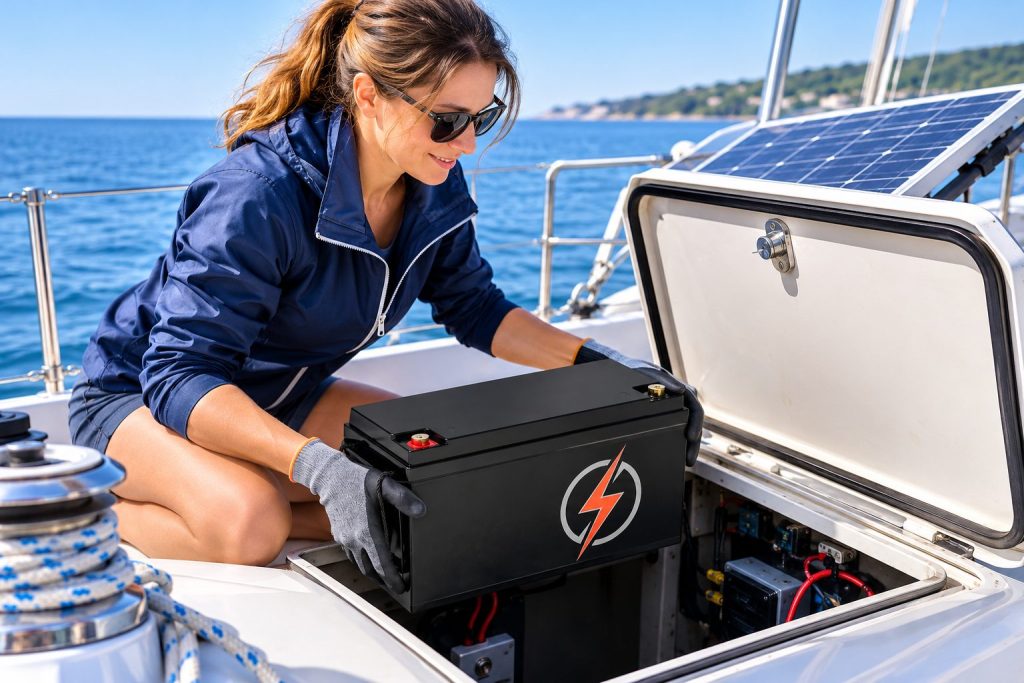
Choosing the right battery is essential for keeping a boat’s electrical systems reliable, whether you use it for fishing, cruising, or longer trips on the water. A suitable marine deep cycle battery provides steady power to equipment such as navigation lights, fish finders, radios, GPS units, pumps, and other onboard accessories. However, not every battery is designed for the same purpose, and selecting the wrong type can lead to poor performance, shorter service life, or unexpected power loss.
- Understand the Different Types of Marine Batteries
- Decide Whether You Need a Starting Battery or a Deep-Cycle Battery
- Calculate Your Boat's Power Requirements
- Check Voltage, Capacity, and Compatibility
- Choosing the Right Battery for a Motorcycle or Boat
- Can You Use a Car Battery for a Motorcycle or Marine Application?
- Understand Battery Performance and Charging
- How Long Do Marine Deep-Cycle Batteries Typically Last?
- What to Look for When Buying Marine Deep Cycle Batteries
- Conclusion
Before buying a battery, it is important to understand the different battery technologies, your boat’s electrical requirements, and the amount of power you need during a typical trip. Capacity, voltage, charging compatibility, physical dimensions, and maintenance requirements should all influence your decision. This guide explains how to compare the available options and choose a battery that matches your vehicle or marine application.
Understand the Different Types of Marine Batteries
Marine batteries are designed to handle the demanding conditions found on boats, including vibration, moisture, and repeated charging and discharging. However, their construction and intended uses vary. Understanding the main types will help you narrow down your options.
Flooded Lead-Acid Batteries
Flooded lead-acid batteries are a traditional and often affordable option. They contain liquid electrolyte and are commonly used in marine applications. Many models are designed for deep-cycle use, meaning they can supply power over an extended period rather than delivering only a brief burst of energy.
Their main advantage is their relatively low purchase price. However, they require more attention than sealed alternatives. Some models need regular electrolyte-level checks and must be installed in a properly ventilated area. They should also be kept upright to prevent spills.
AGM Batteries
Absorbed Glass Mat (AGM) batteries are sealed lead-acid batteries in which the electrolyte is held in glass-fibre mats. They are generally maintenance-free and offer good resistance to vibration, making them a popular choice for boats and recreational vehicles.
AGM batteries can deliver reliable power and usually recharge more efficiently than conventional flooded batteries. They are also less likely to leak when installed correctly. Their main drawback is a higher purchase price, and they still need a compatible charging system to avoid damage.
Gel Batteries
Gel batteries use an electrolyte suspended in a gel-like substance. Their sealed construction makes them resistant to spills and suitable for certain marine environments. They can provide steady power and are often selected for applications where controlled discharge is important.
However, gel batteries are sensitive to charging voltage. Using an unsuitable charger or an incorrect charging profile can shorten their lifespan. Always check the manufacturer's charging specifications before choosing one.
Lithium Batteries
Lithium iron phosphate (LiFePO4) batteries are increasingly popular in marine and recreational applications. They are lightweight compared with many lead-acid alternatives and can provide a large usable portion of their rated capacity.
They also typically support many more charge cycles than traditional lead-acid batteries. However, their initial cost is higher, and compatibility matters. A lithium battery should include an appropriate battery management system (BMS), and the boat's charger, alternator, and other electrical equipment must be suitable for lithium technology.
Decide Whether You Need a Starting Battery or a Deep-Cycle Battery
One of the most important buying decisions is choosing between a starting battery and a deep-cycle battery. Although they may look similar, they are designed to perform different jobs.
A starting battery delivers a powerful burst of current for a short period to start an engine. It is then recharged by the engine's charging system. A deep-cycle battery, on the other hand, is designed to supply a more consistent amount of electricity over a longer period. It is better suited to powering accessories when the engine is switched off.
For example, a boat with a fish finder, cabin lights, a trolling motor, a refrigerator, and a water pump may need a dedicated deep-cycle battery. These devices can draw power for hours, making a battery designed for repeated discharge more appropriate.
Some boats use dual-purpose batteries that can provide starting power and support accessory loads. These can be useful when space is limited, but a dedicated starting and deep-cycle battery setup may be more suitable for boats with significant electrical demands.
Calculate Your Boat's Power Requirements
Before choosing a battery, estimate how much electricity your onboard equipment uses. This helps you avoid buying a battery that is too small or paying for more capacity than you need.
Start by listing the electrical devices you expect to operate. Check each device's power consumption, usually shown in watts (W) or amps (A), and estimate how many hours you will use it.
If the device's current draw is listed in amps, multiply it by the number of hours it will operate:
Amp-hours (Ah) = Current draw (A) × Operating time (hours)
For example, if a device draws 3 amps and runs for 5 hours, it uses approximately 15 Ah.
Repeat this calculation for each device, then add the results together. It is sensible to include a reserve rather than planning to use the battery's entire rated capacity. Lead-acid batteries generally should not be discharged as deeply as lithium batteries if you want to preserve their service life. The usable capacity also depends on temperature, battery age, discharge rate, and manufacturer recommendations.
A battery with a higher amp-hour rating can generally supply more energy, but capacity alone is not enough. You should also consider voltage, maximum discharge current, and whether the battery can handle the demands of equipment such as a trolling motor.
Check Voltage, Capacity, and Compatibility
Battery compatibility is just as important as capacity. Most small boats use 12-volt systems, while larger vessels may use 24-volt or 36-volt systems for certain equipment. Check your boat's electrical specifications before purchasing a replacement.
A battery's voltage must match the requirements of the equipment it powers. If your boat uses a 24V trolling motor, for example, you may need two compatible 12V batteries connected in series, depending on the motor's design. Connecting batteries incorrectly can damage equipment or create safety risks.
Capacity is measured in amp-hours (Ah). A higher Ah rating generally means the battery can supply a given load for longer, but the actual runtime depends on the equipment's power consumption and the battery's usable capacity.
Also check the following:
- Physical dimensions: Make sure the battery fits securely in the existing battery compartment.
- Terminal type: Confirm that the terminals match your cables and connectors.
- Weight: Consider the effect of battery weight on storage, handling, and boat balance.
- Charging requirements: Verify that your charger supports the battery chemistry and voltage.
- Discharge rating: Check whether the battery can supply the current required by your equipment.
- Environmental protection: Choose a battery suitable for the vibration and conditions expected in your boat.
A well-matched deep cycle marine battery should meet the electrical requirements of your boat while providing enough reserve capacity for normal use.
Choosing the Right Battery for a Motorcycle or Boat
Although motorcycles and boats both use batteries, their power requirements are different. The best choice depends on whether you need to start an engine or operate electrical equipment over an extended period.
Motorcycles generally require compact batteries designed to deliver sufficient starting current. A standard motorcycle starting battery is usually selected according to the manufacturer's specified voltage, dimensions, terminal arrangement, and cold-cranking or starting-current requirements.
Boats may require separate batteries for engine starting and onboard electrical accessories. A deep-cycle battery is generally a better choice for equipment that operates for extended periods, while a starting battery is designed for engine ignition.
If you own both a motorcycle and a boat, do not assume that one battery will suit both vehicles. Even if the voltage is the same, the capacity, dimensions, terminal layout, starting-current rating, and intended duty cycle may differ.
Always consult the vehicle or boat manufacturer's specifications. A battery should only be used when its electrical characteristics and physical design are suitable for the application.
Can You Use a Car Battery for a Motorcycle or Marine Application?
A car battery may appear to be a convenient substitute, but it is not automatically suitable for a motorcycle or boat. Car batteries are usually designed to provide a strong burst of current to start an engine, followed by relatively shallow discharges.
A motorcycle typically requires a much smaller battery that fits its designated compartment and meets its specific starting requirements. A car battery is usually too large and may have incompatible terminals or mounting arrangements. It should not be used as a replacement simply because its voltage matches.
Marine applications require even more careful consideration. A standard automotive starting battery may work in certain engine-starting situations if the manufacturer permits it and the installation is appropriate. However, it is generally not the best choice for powering accessories over extended periods. Repeated deep discharging can damage a conventional starting battery and reduce its lifespan.
Marine batteries are also designed with the demands of boating in mind. Depending on the model, they may offer improved resistance to vibration and construction suited to marine use. For powering lights, electronics, pumps, and other accessories, choose a battery specifically rated for deep-cycle operation.
Understand Battery Performance and Charging
A battery's performance depends on more than its advertised capacity. Charging habits, operating temperature, discharge depth, and electrical load all influence how well it performs.
A suitable charger is essential. Different battery chemistries have different charging requirements, so a charger designed for flooded lead-acid batteries may not be appropriate for gel or lithium batteries. Many modern chargers include selectable battery modes, allowing users to choose the correct charging profile.
Avoid leaving a battery deeply discharged for long periods. This can be particularly damaging to lead-acid batteries. Recharge it according to the manufacturer's instructions and check its condition before long trips.
It is also important to avoid overcharging. Excessive charging voltage can cause heat buildup and damage, especially in sealed batteries. Lithium batteries should be charged using equipment compatible with their chemistry and BMS requirements.
For boats with multiple batteries, use the correct wiring arrangement and suitable cables, fuses, and isolation equipment. Incorrect connections can cause overheating, poor performance, or electrical hazards. If you are unsure about the installation, consult a qualified marine electrician.
How Long Do Marine Deep-Cycle Batteries Typically Last?
The lifespan of a marine battery depends on its chemistry, quality, usage, charging routine, and storage conditions. There is no single lifespan that applies to every battery, but typical ranges can help you compare options.
|
Battery type |
Approximate service life |
|
Flooded lead-acid |
2–5 years |
|
AGM |
3–6 years |
|
Gel |
3–6 years |
|
LiFePO4 lithium |
8–10+ years |
These figures are general estimates, not guarantees. Some batteries may last longer with careful maintenance, while heavy use, poor charging, excessive heat, or frequent deep discharges can shorten their service life.
Battery lifespan is also measured in charge cycles. A cycle generally represents the use of energy followed by recharging, although manufacturers may define cycle testing under specific conditions. Lithium batteries often support substantially more cycles than lead-acid batteries, but actual results depend on discharge depth and operating conditions.
To help your battery last longer:
- Recharge it promptly after use, following the manufacturer's instructions.
- Avoid discharging it beyond its recommended depth.
- Keep terminals clean, dry, and securely connected.
- Store the battery in a suitable location when the boat is not in use.
- Avoid exposure to excessive heat.
- Check the battery periodically for damage, corrosion, or unusual performance.
- Use a compatible charger and follow the recommended maintenance schedule.
If a fully charged battery begins losing power unusually quickly, struggles to operate normal equipment, or fails to hold its charge, it may need testing or replacement.
What to Look for When Buying Marine Deep Cycle Batteries
Once you understand your power needs, compare products based on their specifications rather than price alone. A low-cost battery may be attractive initially, but it may not offer the capacity, cycle life, or durability required for your boat.
Consider these important features:
Battery chemistry: Choose between flooded lead-acid, AGM, gel, and lithium based on your budget, maintenance preferences, and expected usage.
Capacity and voltage: Make sure the battery meets the requirements of your boat's electrical system and provides enough usable energy.
Cycle life: Check the manufacturer's cycle-life information and the conditions under which it was measured.
Charging compatibility: Confirm that your existing charger and charging system support the battery type.
Construction and durability: Look for a design suited to marine use, including resistance to vibration and a secure installation arrangement.
Warranty and support: Review the warranty period, coverage conditions, and availability of technical assistance.
Installation requirements: Check the recommended mounting position, ventilation requirements, cable sizes, and safety instructions.
Comparing these factors can help you find a battery that provides dependable performance without unnecessary expense.
Conclusion
Choosing the right marine battery starts with understanding how much power your boat needs and which electrical systems you plan to operate. Starting batteries are designed to deliver a short burst of power for engine ignition, while deep-cycle models provide steady electricity to onboard accessories over longer periods. Battery chemistry, capacity, voltage, charging compatibility, physical dimensions, and expected lifespan are all important factors to consider before making a decision.
For dependable operation, select a battery designed for marine applications and follow the manufacturer's recommendations for charging, installation, and maintenance. Whether you operate a small fishing boat or a larger vessel with multiple electrical systems, comparing battery specifications carefully will help you find a suitable solution. Explore the available marine battery for boats options from VEVOR to compare deep-cycle batteries for your boating power requirements.
Technical accuracy note: Battery lifespans are approximate and vary depending on usage, charging practices, maintenance, and manufacturer specifications. Always ensure that the battery chemistry is compatible with your charging system, and choose a deep-cycle battery for sustained accessory loads rather than relying on an ordinary starting battery.