Meal prep for a school week works best as two short cooking sessions, one early in the week and one midweek. Cooked food keeps for about three to four days in the fridge, so a single session on Sunday leaves Thursday and Friday meals past their best. Two sessions of an hour or so, plus a freezer for the extras, cover a whole week.
- How Long Does Prepped Food Last in the Fridge?
- What Should You Cook in the Two Sessions?
- What Equipment Do You Need to Start?
- How Do You Cool, Pack and Label Food?
- How Do You Reheat Prepped Meals Safely?
- How Long Can You Keep Food in the Freezer?
- What if You Share a Fridge?
- How Do You Stop Meal Prep From Getting Boring?
How Long Does Prepped Food Last in the Fridge?
Cooked leftovers last about three to four days in the fridge, according to the US Department of Agriculture. The fridge should be at 40 F (4 C) or colder, and the freezer at 0 F (minus 18 C) or colder.
Rice is the exception. The UK’s National Health Service says cooked rice should go in the fridge within one hour and be eaten within 24 hours, because leftover rice can grow bacteria whose toxins reheating does not remove. It also says rice should be reheated only once. Plan rice for the first day of each session or cook a fresh batch when you need it.
Hard-cooked eggs keep about a week in the fridge, which makes them one of the easiest prep items.
What Should You Cook in the Two Sessions?
Cook the meals you will eat in the next three days, and freeze the rest. The plan below assumes lunches and dinners at home and a shared fridge.
| Session | What to cook | Eat on |
|---|---|---|
| Sunday afternoon, about an hour | A big pot of chilli or lentil soup, a tray of roasted vegetables, boiled eggs | Monday to Wednesday |
| Wednesday evening, about an hour | A different main, such as pasta bake or a curry, and a second tray of vegetables | Thursday and Friday, with extra portions frozen |
| Anytime | Freeze two or three portions of each main in the first sessions | The following week |
Choose meals that taste good reheated. Soups, stews, curries and pasta bakes do. Crisp salads and fried food do not, so make those fresh or add them at the table.
What Equipment Do You Need to Start?
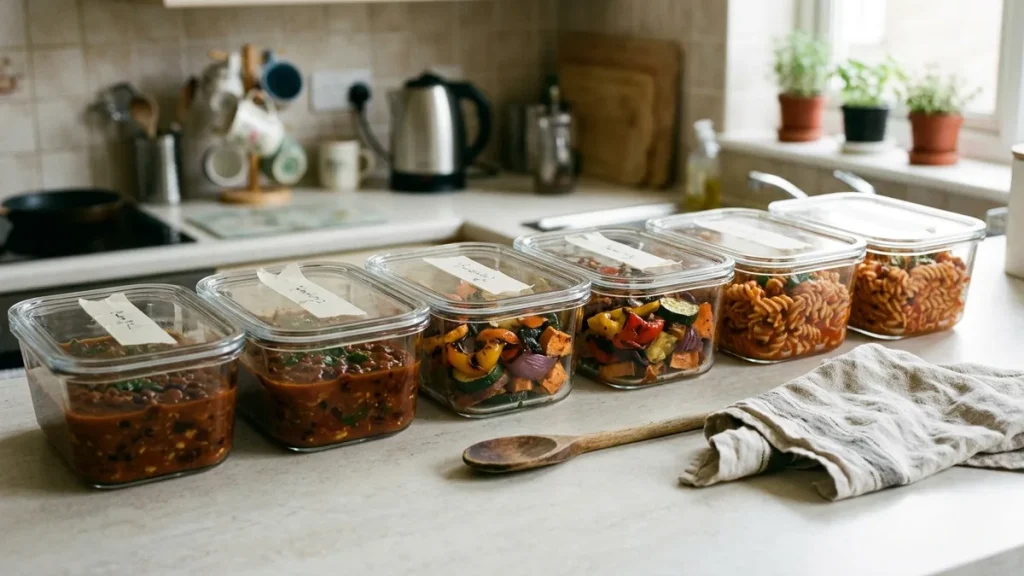
You need less than you might think: a large pot, a baking tray, a sharp knife and a set of lidded containers that are safe for the microwave and freezer. A probe thermometer is a useful extra, and so is a roll of masking tape and a marker for labels.
Buy containers in one shape so they stack and the lids are interchangeable. Glass lasts longer but is heavier to carry, while plastic is lighter. Use whichever suits the way you travel to class.
How Do You Cool, Pack and Label Food?
Get cooked food into the fridge within two hours, or within one hour if the room is hotter than 90 F. The faster it cools, the less time bacteria have to grow.
- Divide hot food into shallow, covered containers so it cools more quickly.
- Put containers in the fridge or freezer without waiting for the steam to stop.
- Stick a strip of tape on each lid with the dish name and the date you cooked it.
- Put the oldest containers at the front so you eat them first.
- Freeze anything you will not eat within three days.
Portion sizes matter. A single serving per container cools faster than a big tub and is easier to grab on the way to class.
How Do You Reheat Prepped Meals Safely?
Reheat leftovers until they reach 165 F (74 C), checking with a food thermometer if you have one. Stir halfway through in a microwave and cover the dish so the heat spreads evenly.
Soups, sauces and gravies should be brought to a rolling boil. Only heat the portion you plan to eat, because every extra round of heating and cooling gives bacteria another chance. Rice should not be reheated more than once.
How Long Can You Keep Food in the Freezer?
Food kept at 0 F stays safe in the freezer, but its quality drops over time. For cooked leftovers, the US Department of Agriculture mentions three to four months for the best taste and texture.
Write the date on frozen containers, and move one portion to the fridge the evening before you want it.
What if You Share a Fridge?
Label every container with your name and date, and agree on a shelf or a box. A fridge shared by four people fills fast, so shallow stackable containers use space better than round tubs.
Ask your flatmates before you take over half the freezer, and offer something back, such as a portion of soup. If your fridge is not cold enough, the plan fails, so a cheap fridge thermometer is worth having. It tells you whether the temperature is 40 F or below.
Cook twice instead of once: two short sessions beat one long Sunday.
How Do You Stop Meal Prep From Getting Boring?
Change the toppings, not the base. The same pot of chilli can go over rice one day, in a wrap the next and on a baked potato later in the week.
Keep one fresh item per day, such as fruit, a raw vegetable or a salad, to give the container a lift. A bottle of hot sauce or a lemon costs little and changes the flavour of a reheated dish completely. If you are getting tired of a recipe by the second day, freeze half of the next batch instead of forcing yourself to eat it.